Gahwa Time: The Voice of Saudi Coffee’s Living Heritage
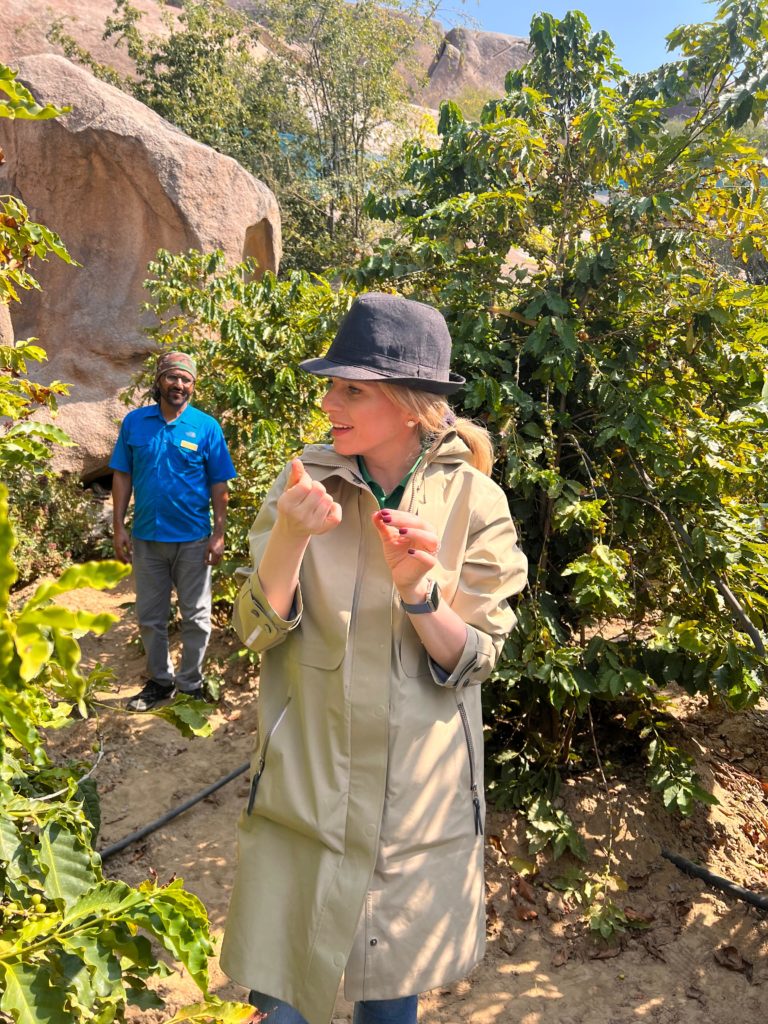
MAY 2023: BAHA, SAUDI ARABIA – In the highlands of Baha, nestled among the cliffs of the Sarawat mountains, coffee is not just a drink. It is a heritage. A silent pact handed down from generation to generation – not always in words, but through hands, soil and waiting.
As a Tunisian in love with Gahwa Arbi, I threw myself body and soul into discovering the Saudi heritage so carefully guarded by the women of Sarawat. Here I share with you everything I learned during my stay, organised by Gahwa Time/CIE.
_______________
Thirty years ago, most Saudi families left their ancestral farms for urban life, leaving behind the old terraces and the rhythm of the seasons. The ancient rhythms – dictated by rain, blossoming and harvest – gave way to the tempo of the city. Yet while the many followed new paths, a few men and women stayed on the land, tending the trees, protecting the seeds and keeping alive a way of life that might otherwise have vanished.
Traditionally, in Arab culture, coffee was prepared by the man – roasted, ground and brewed in front of the tent, or by his helpers – before being proudly offered to guests. When life moved into villas and cities, this sacred role was quietly passed on to the woman of the house. Trained, refined and charged with upholding its elegance, she prepared the coffee with such precision that her husband could still serve it with pride.
But in the mountains of Baha, where the land remembers ancient footsteps and the terraces still hold the echo of the ancestors, a group of women did not merely prepare coffee – they grew it. While men and women tended the trees and nurtured the seeds, Sara Sawaf discovered a group of women who were the guardians of quality – meticulously selecting only the ripe red cherries and drying them in the sun on stone rooftops. Their watchful eye ensured that each harvest upheld the integrity of a tradition that might otherwise have died out.
Today, their quiet perseverance finds a voice through Gahwa Time, a cultural initiative led by Sara Sawaf, founder and CEO of Coucou International Entertainment Inc. (CIE) – a Canadian agency combining event production, edutainment and storytelling. Sawaf’s mission is bold: to reconnect people around the world through the original pulse of Saudi generosity – its coffee – while honouring the men and women who stayed on their land and made it possible.
“This is not about glorifying hardship,” says Sara. “It is about finally recognising those who did not leave. They did not choose visibility – but they chose responsibility. And thanks to them, the roots held.”
In the fields of Baha, those roots run deep – more than 4,000 years, according to archaeological and oral histories. Once a crossroads of the incense trade and of pre-Islamic poetry, Baha was a highland sanctuary where mountain wisdom and agriculture flourished. Coffee, introduced centuries ago through maritime trade with East Africa, became more than a crop: it became a symbol of welcome, of pause, of peace.
Through Gahwa Time, Sawaf organises not only gatherings around coffee, but spaces of cultural reawakening. Each session is at once a storytelling circle and a sensory ritual. Guests taste locally grown beans, learn the stories of the men and women who cultivated them, and leave with more than a cup in their hand – they leave with a thread of continuity.
The project, though modern in its reach, resists the clichés of corporate empowerment. There are no flashy advertising campaigns. Just the humble strength of women like Umm Khaled, 65, who has never left her village and still dries her beans on flat stone rooftops. Or Bashaer, 24, who travels with her father and siblings to sell coffee beans across the kingdom.
“We were not meant to be seen,” says Bashaer with a smile. “But we were always there.” Coucou International Entertainment Inc. (CIE), under Sara’s leadership, will work to make these voices heard in new arenas – global forums, educational platforms, podcasts and public installations. But Gahwa Time remains anchored in one thing: the moment. That sacred pause when coffee is served not as a product, but as a gesture of relationship.
But the story does not end in nostalgia. When Sara took coffee samples to be assessed at a quality laboratory in Switzerland, the feedback was constructive: improving harvesting precision – especially by picking only ripe red cherries – would raise the quality. Several farmers took this advice to heart, carefully refining their techniques. When Sara returned to Baha, she was both relieved and deeply moved to find a group of women already practising this level of care – meticulously sorting each batch with an instinct honed over generations. Their quiet commitment became the key to preserving both flavour and tradition.
Inspired by this progress, she now looks forward to seeing more farmers in the region raise their standards and produce beans that truly reflect the potential of Baha’s terroir. In a world increasingly shaped by division, Sawaf sees Saudi coffee, rooted in heritage, as a gentle bridge – across generations, borders and the false divide between modernity and tradition.
“To be offered coffee in Baha,” says Sara, “is to be welcomed with generous hospitality – and to be offered survival, dignity and memory in every cup.” And perhaps, in that gesture, something even more radical: a future rooted in what never left.
_____________
Baha coffee at a glance – with sensory notes
- Altitude: 1,800–2,400 m – Slow ripening at high altitude yields a richer, more concentrated flavour.
- Variety: Arabica
- Method: Hand-picked, sun-dried
- Flavour: Earthy, floral, slightly acidic – Verified by Swiss laboratory analysis, Baha coffee reveals notes of chocolate, roasted hazelnut and sweet nut, with a syrupy body, a clean finish, and scores of 10/10 for sweetness, uniformity and cleanliness.
- Cascara (coffee cherry skin): Brewed on its own, cascara offers a soft, honeyed infusion – with notes of chamomile, toast and herbs – and a surprisingly syrupy texture. A tribute to the whole fruit and to the zero-waste culture rooted in local tradition.
__________
Houda Ghorbel, PhD in Arts Science
Art Critic
Assistant Professor at the Tunis Higher Institute of Fine Arts
President of Femmes-Actions pour un Monde Eco-responsable (FAME)
Artistic Director of the African art movement Émouvance des Émouvants